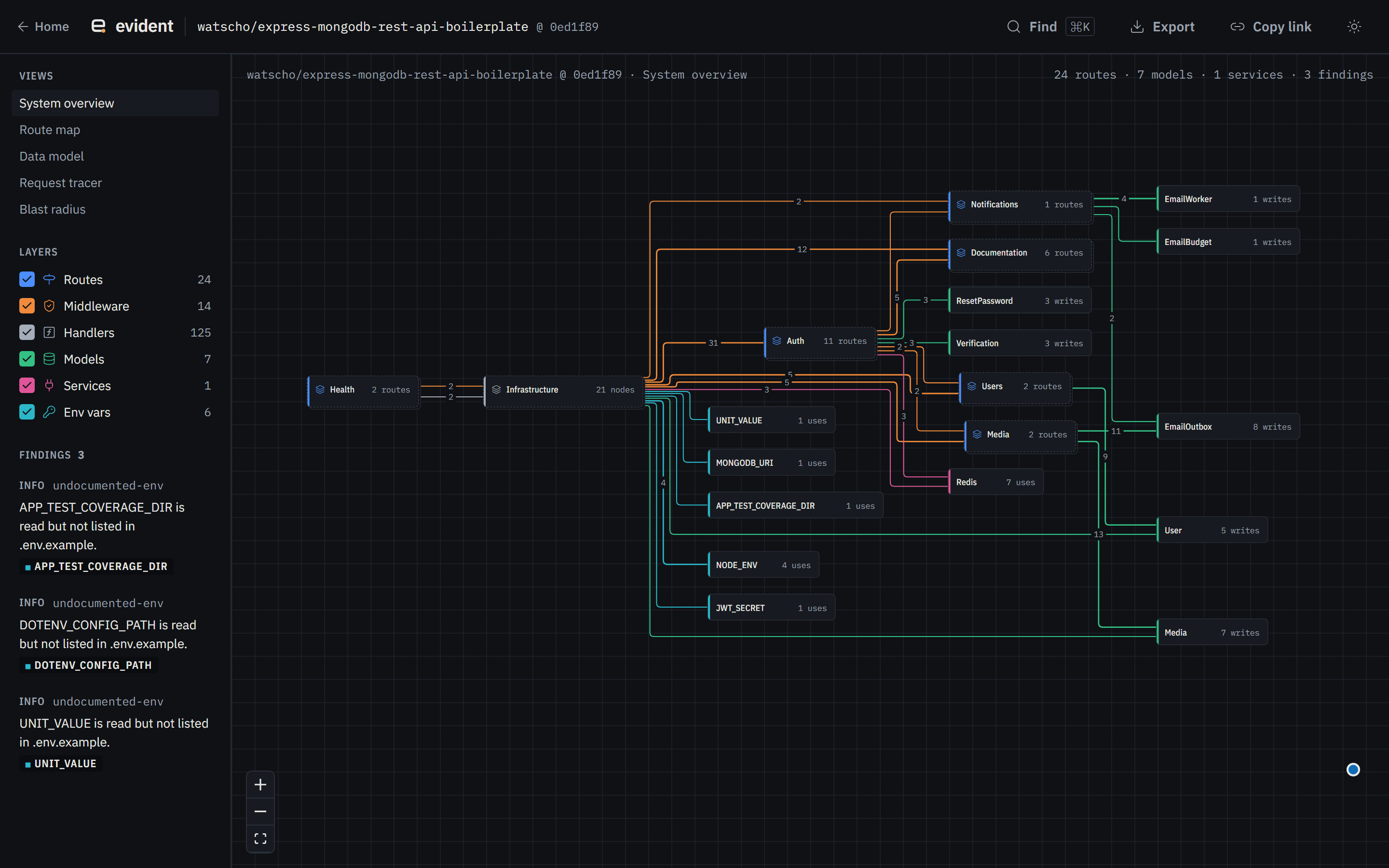
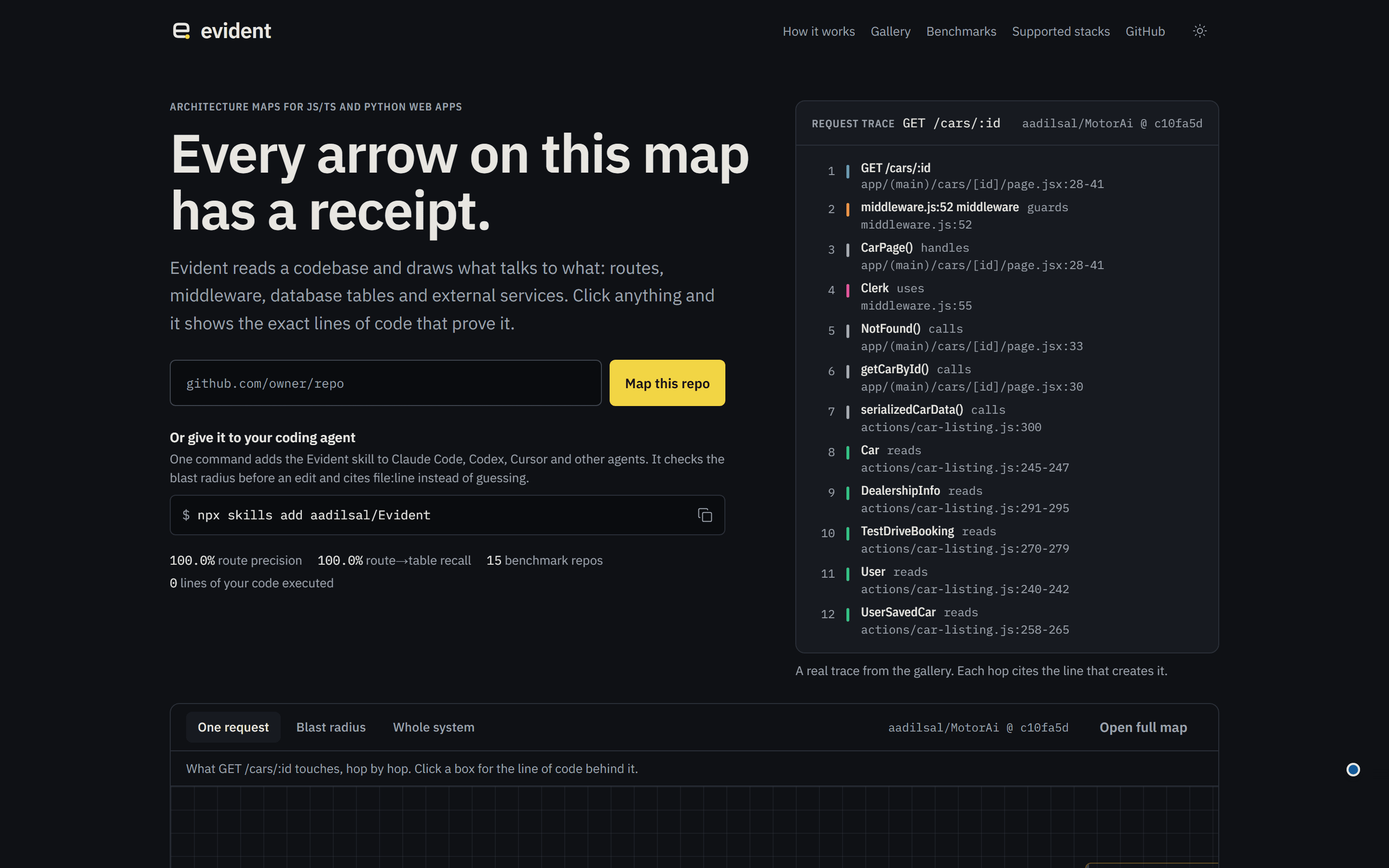
Evident reads a codebase and maps its routes, middleware, database tables and external services. Every box and arrow cites a file, a line range and a commit, and if it can't point to a line, it doesn't draw it.
When you join a codebase or review a pull request in one you don't know, the first question is what talks to what. Which routes write to the User table? What breaks if I change Invoice? Is this endpoint behind auth?
AI diagram tools answer with an LLM's guess from the file tree. It looks convincing until you spot a service that doesn't exist, and coding agents make the same guesses when they edit code they haven't read. I wanted a map where every claim can be checked.
What I built
01
Every edge has a receipt
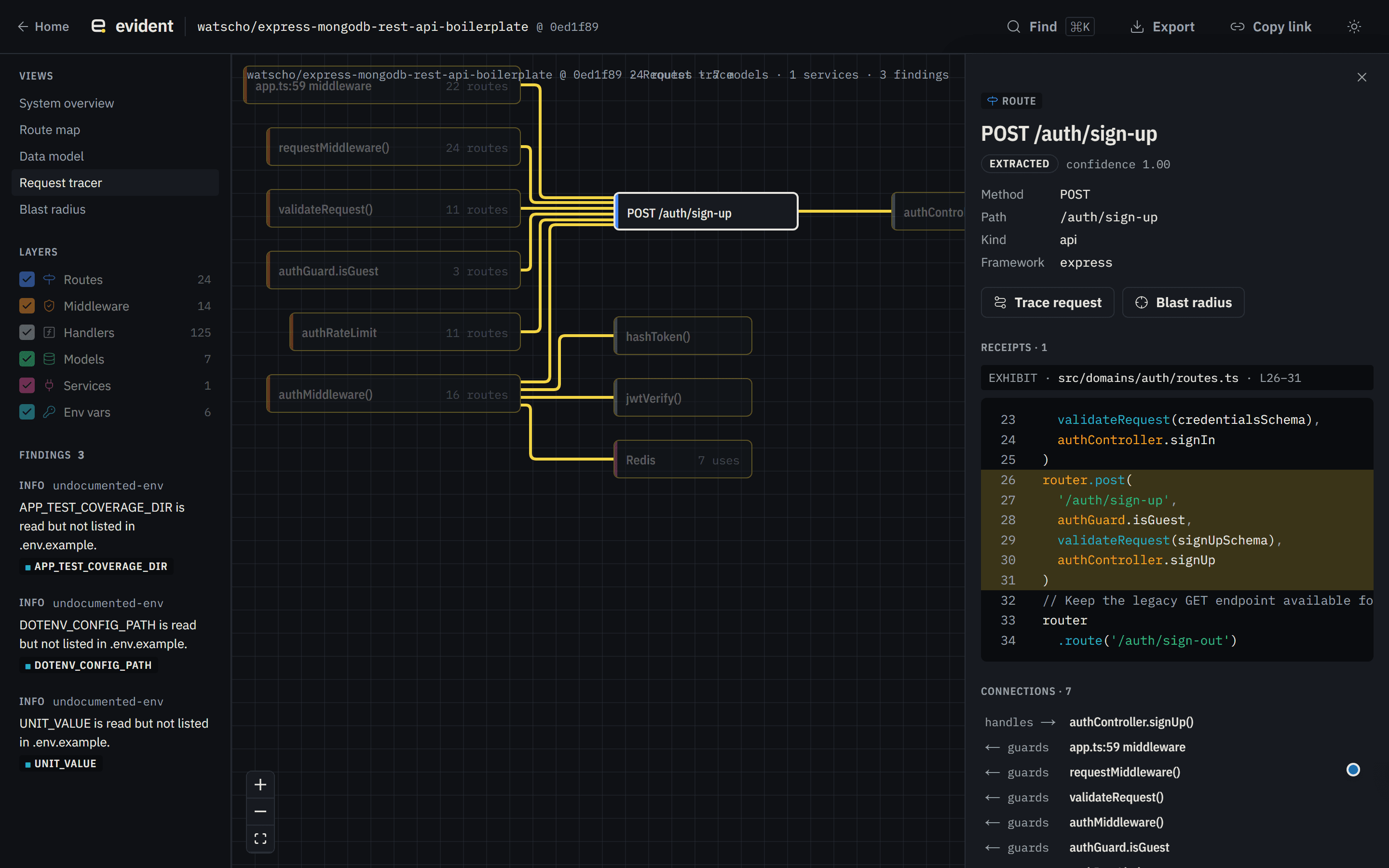
Click any box or arrow to see the file, the line range and the highlighted code behind it, with a badge saying whether it was extracted from code or inferred by grouping. The request tracer follows a route through middleware, handler and service to the tables it touches.
02
Blast radius before you change something
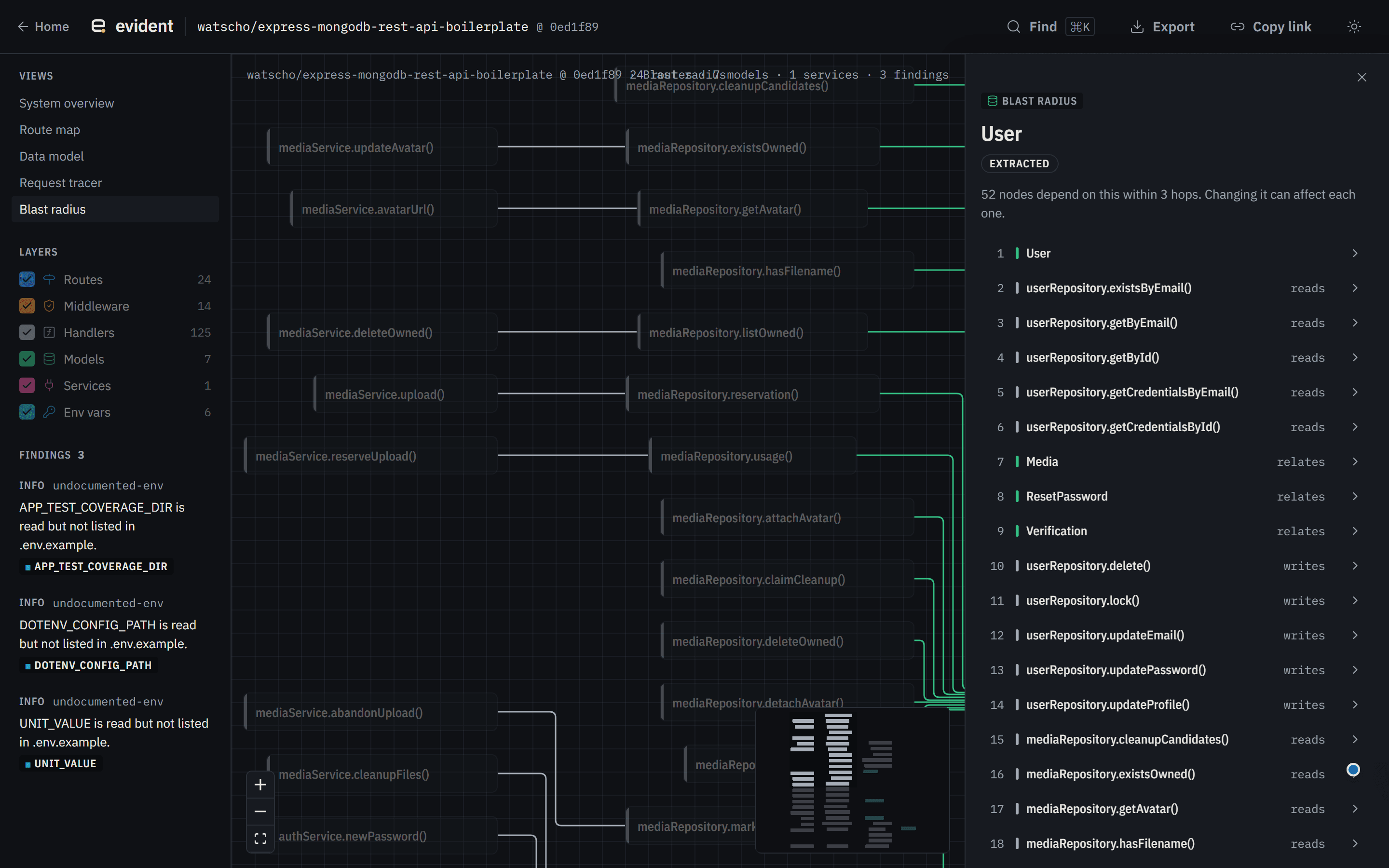
Select a model, file or env var and Evident lists everything that depends on it, hop by hop, with whether each one reads, writes or relates. Health checks flag things like a write route with no auth middleware or an env var missing from .env.example.
03
Map any public repo
Paste a GitHub URL on the site and the engine shallow-clones it, parses it and serves the map. Results are cached per repo and commit, so the same commit is only analysed once.
04
Built for coding agents too
The engine is a CLI, evident-map on PyPI, with schema-valid JSON on every command. A skill makes Claude Code, Codex and Cursor run impact before editing a model and cite file:line instead of grepping. On 12 architecture questions run twice each with Claude Haiku, answers passed 24 of 24 times with the skill and 21 of 24 without.
How it fits together
A six-stage engine. The LLM only labels nodes that already exist, and a validator rejects anything else.
Repo, parsedtree-sitter, never run
Adapters and linkerroutes, models, edges
LLM groupinglabels existing IDs only
Web mapNext.js, React Flow
CLI and agent skilltrace, impact, health
Decisions and trade-offs
A parser for facts, an LLM only for names
tree-sitter extracts the routes, middleware, models and calls. The LLM can only group and label nodes that already exist, and its output must reference real node IDs, so it can't invent a component.
Trade-off: the map only shows what static analysis can prove, so a route registered at runtime from a database won't appear.
One adapter per framework, not every language
Express mounts, NestJS modules, Django URLconfs and Flask blueprints each resolve differently. A dedicated adapter per framework, with its own fixtures and benchmark cases, is what makes a complete map possible.
Trade-off: Spring, Laravel, Rails, ASP.NET and Go stacks only get the generic module and service map for now.
Accuracy as a number CI enforces
A labelled benchmark of 15 repos, 7 of them public open-source apps, scores every engine change per category and per adapter. The build fails if any metric drops by more than 2 points.
Trade-off: every new adapter needs labelled repos before it ships. Labelling the public ones exposed real gaps, each now a regression test.
Results
100%
route precision and recall across 592 routes in the 15-repo benchmark
24/24
agent answers passed with the Evident skill, vs 21/24 without